lec01. what’s constructive logic?
Table of contents
Open Table of contents
1. course overview
four main topics:
- proofs as evidence for truth.
- proofs as programs. relate logic and program via Curry-Howard isomorphism. we can interpret formulas as types, proofs of such formulas are actually programs of corresponding type.
- proof search as computation.
- advanced topics. linear logics, resolutino, theorem prover.
2. what’s logic
3. why anothor logic?
law of excluded middle: either or holds.
Some theorems relies heavily on the law.
Constructive logic: the truth of a judgment is solely determined by an evidence of that judgment. It can be thought of as a proof-centered logic, and can be interpreted as algorithms.
4. First steps
Work with first-order logic.
- conjunction:
- disjunction:
- implication:
- false:
- true:
- universal:
- existential:
We don’t use negation(), instead can be written as . We use upper case letters for formula variables. Lower case letters are reserved for predicate symbols and terms.
Defintion 1(Terms). The set of terms is inductively defined as follows:
- a variable is a term (x, y, z…)
- If f is a function symbol of arity n, then is a term. In particular, if f has arity 0, it’s called constant.
Definition 2(Formulas). inductively:
- If p is a predicate symbol of arity n, then , for terms is a (atomic) formula.
- If A and B are formulas, then
the precedence of logical operators:
Consider the following formulas:
Here, even is a predicate symbol, s is a function symbol. Both and are terms.
- predicate symbol: combines terms and produces a predicate
- function symbol: combines terms and produces a new term.
In order to build proofs, we need to use a proof calculus. We’ll use natural deduction and sequent calculus, which use the same kind of building blocks: inference rules.
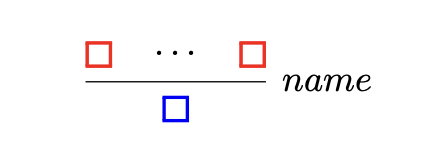 red boxes are judgments for premises; blue box called conclusion.
A judgment is simply an assessment about an object.
An inference rule is interpreted as: if all the premises hold, then I can correctly conclude the conclusion.
Inference rules are presented with schema variables.
An inference rule can have zero premises, called axiom.
A proof is constructed by plugging in inference rules together, can be represented as a tree and a DAG.